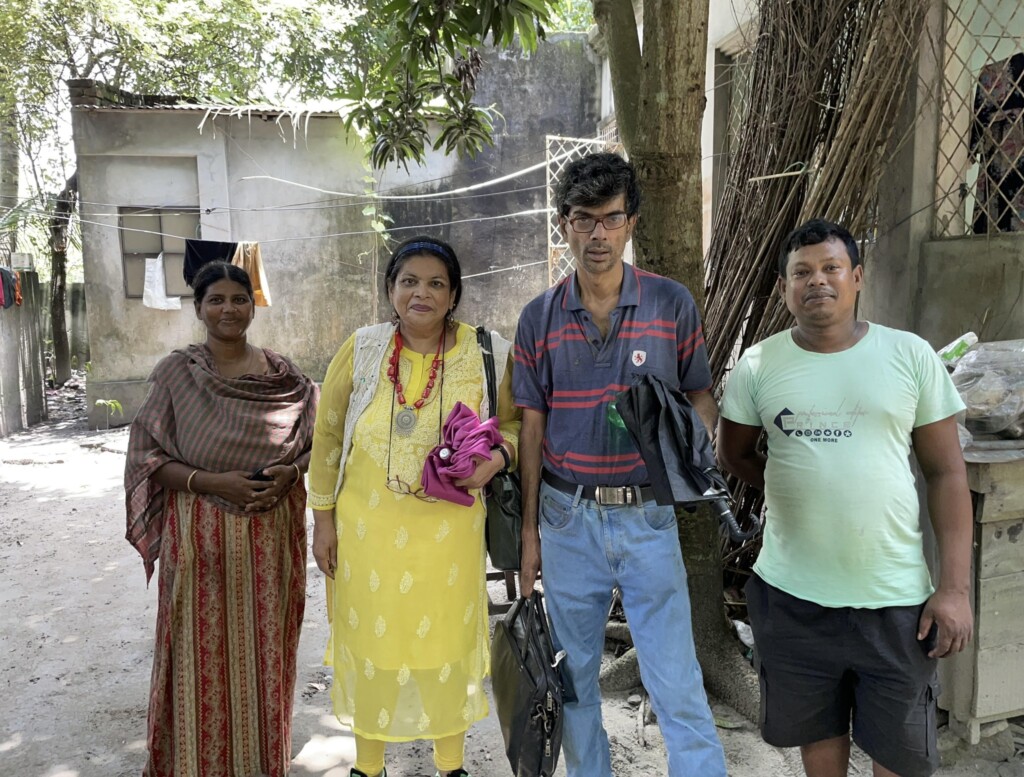
The following is my personal experience, it may or may not correspond to what others experience. No one can or (using an imperative) should judge a culture or history of a land by being there for less than a fortnight. I stayed in Bangladesh for 10 days and 9 nights, and what I shall say is personal for me (unless one takes the personal to be political). It was a journey to my family’s history and past, a nostalgic journey into my ancestors, a history that is for me entirely personal (and political). I grew up hearing stories about the land and so it was all familiar to me. When eventually, I went back, it seemed more like a dream than reality. The people are polite and hospitable, and I ate some of the delicious food, although my constitution does not permit the spicy food they use.
Some of the interesting things were the roads in Dhaka. The traffic is disorganized, reminding me somewhat of Calcutta traffic in the 1980s. Cycle rickshaws, autos (covered two wheelers) usually take liberty with the road and with each other, people going where they want to, and saving themselves from collision meticulously at the last moment. I visited their marvelous bridge, Padma Setu, and the architecture of that show cased that special fish, a culinary delight for most Bengalis on both sides of the border. The landscape is gorgeous, lushy green with canopy of trees making gentle shadows on the highway. I visited several Hindu sites and asked if I could visit the Buddhist sites. The Hindu Temples looked quite functional and it did not seem that people were too excluded. Little bits and pieces of conversion, however, revealed their minority status in a theocratic state. When I visited my paternal forefathers home (now occupied by some people), they were not at home, so we could not enter. We visited the neighbor and there were two ladies, an elderly one, the mother, and a younger daughter, whose husband passed away. At first she was a little cautious and then heard we are Hindus from India, smile broke in her face and she said with a genuine glee, “You guys are Hindus?” There is a Kali Temple nearby, which seemed quite functional. When asked the lady said it is a Hindu village and they never face any discrimination. Nonetheless, having been trained psychoanalytically, through gestures and some silences I could feel her relief on hearing that we are from her faith, which shows that there is always a feeling of exclusion and alienation in their own land. Then there were people in Chittagong, including my dear friend, Imran Sohel, whose family took pains to cook for us the entire day and laid down a sumptuous dinner. I have never seen so many items all at once. It was like being treated by royalty. For the safety of my friend I cannot put their picture here.
Having said all of the above, could I have lived in Bangladesh? Probably not. I am a minority in the USA, so what would have been a difference in terms of exclusion (except the disorganized traffic!). There is a difference between being a minority in a secular state like India and the USA and a theocratic state. One example, there are verses from the scriptures in the elevator in a 5 star hotel, there are verses from the scriptures in most public places. Secularism does not do away with religion, it privatizes it, by making a division between the public and the private. Marx talked of “secularism” as a ploy (hypocrisy) of the liberal bourgeois class, feminists also reject the bourgeois liberal (and ideological) notion of the public/private dichotomy. Nonetheless, at this stage in human history, possible, there is a need for this kind of liberal bourgeois (although ideological) division, so that a civil society outside of scriptural injunction can grow.
Now, a point that is important for me. I saw a lot of women in the urban and rural areas in either hijab or full Burkha. There is nothing wrong in that, Hindu women (mostly) put on Sindoor and mangal sutra, etc. What I found scary (again the difference between a theocratic state and secular one), is as I was told, in most cases, wearing a hijab is a pre condition for their getting a job (like the receptionist of a five star hotel wearing a hijab, probably without which they would not have gotten the job, etc). There is structural mandate for these, unlike what is written on women’s bodies in a secular nation. Secular nations do not do away with religion, it privatizes it, hence someone’s dress code is catered towards the market, not commanded by religious edits. Since women’s bodies are keepers of culture, these edits are enforced from the State. It is adopted and internalized by women and perpetuated in culture. Such top down mandates are not palatable for me, I prefer to live in a society where a large civil society and pluralism are accepted and my minority status is not a reason for me to be embarrassed. So far, India and US (the two nations where I lived most of my life), have reached some sort of bourgeois liberalism, Bangladesh, is probably not there yet.
Now, the last point, which for me is most important. The structural and systemic arrangement in a theocratic nation is based not reason but on scriptures. I found it interesting that even the intellectuals and so called “left wingers”, stop short of critiquing this structure and bringing in a secular society. It is not that some do not want reforms, but most of the intellectuals put the problems in their society to their Big brother neighbor and in this way their critique is almost identical to the left wing critical discourse of the their big neighbor. This shows that the intellectuals have not evolved their own Subject position and use the same narrative of “leftism” that their neighbors do, they do not critique the systemic and structural arrangement of a theocratic nation. Voices of dissent are not allowed if they critique the systemic scriptural arrangement, they are allowed in stuff other than the system. Hence, those who critique the structure of the nation are ex communicated from the nation. They cannot even live in the nation. It is this that would have made my living in Bangladesh impossible. A society that is not self critical eventually cannot sustain, as history shows. We have to see how the future of Bangladesh evolves….
My love to the wonderful people and its beautiful landscape.. let them thrive and be at peace…